
Oldhammer Savage Orcs – Painting Classic Metal Orcs for Warhammer Fantasy Battle 3rd Edition
Finished at Last: My Oldhammer Savage Orcs
I've finally managed to finish a unit of Oldhammer Savage Orcs that had been sitting on my painting bench for ages. Every time I thought I was done, there always seemed to be one more detail that needed attention!
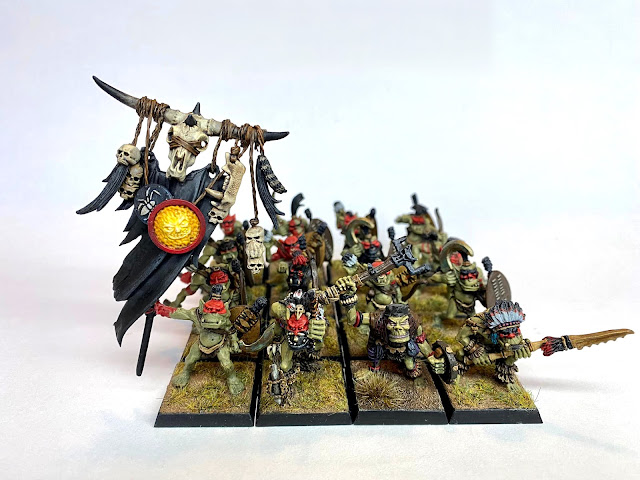
These are classic metal Orc miniatures for Warhammer Fantasy Battle 3rd Edition, and they'll be joining my Orc and Goblin army. I wanted to give them a distinctly tribal appearance, with natural materials, war paint, hide shields and plenty of bones, feathers and other trophies.
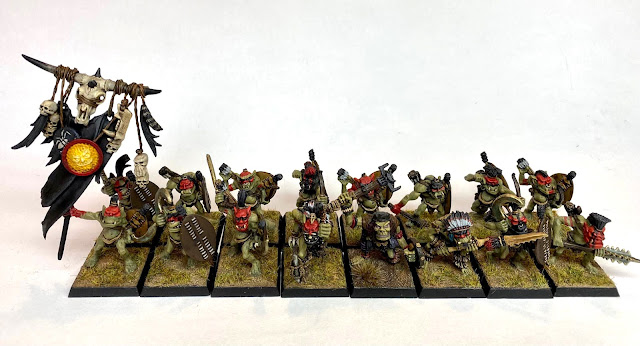
Savage Orcs have always appealed to me because they offer something quite different from the more heavily armoured Orcs in the Warhammer range. Rather than relying on metal armour and conventional weapons, I wanted these warriors to look as though they came from an isolated mountain region where old traditions and primitive equipment had survived for generations.
The Orc Hero – Stranger Come Knocking?
First up is an Orc hero. I haven't settled on a name for him yet, but I think he deserves something suitably imposing and tribal. Perhaps Stranger Come Knocking or Tul Duru Thunderhead?


He's armed with a stone-headed axe and a boomerang, and I love the amount of detail packed into this miniature. He's covered in bones, teeth, feathers and bird skulls, with a bone piercing through his nose. Even the clothing has plenty of character, with visible stitching and fur around the edges of the hides.
These are the sorts of details that make the older Citadel metal miniatures so enjoyable to paint. There's a real sense that the Orc has collected his decorations and equipment over many years, taking trophies from defeated enemies and using whatever materials are available to him.
I wanted to bring out all those details without making the model too colourful or distracting from its overall appearance. The combination of natural materials and war paint helps give him the look of a tribal leader who has earned his status through strength and experience.
Groldog – Shaman, Champion or Something Else?
Next is Groldog. I'm not entirely sure whether to treat him as a shaman, a champion or simply another hero for the army, but he's certainly one of the more characterful models in the unit.


He's armed with a bone spear and has three severed heads hanging from his belt. They're rather small, so perhaps they're the heads of children — or maybe they're shrunken heads collected as trophies!
Like the other Savage Orcs, Groldog is decorated with bones, bird skulls and pieces of hide. The sculpt includes lovely details in the clothing, particularly the stitching and fur, which help make the model feel suitably rough and primitive.
I enjoy painting miniatures like this because they give you plenty of opportunities to experiment with different textures. Bone, feathers, fur, leather and skin all need slightly different treatments, even when they're packed together on a relatively small model.
Painting the Savage Orc Warband
Here's the whole Savage Orc unit together.
In Warhammer Fantasy, Savage Orcs are known for their war paint, which they believe protects them in battle. I wanted to make this a strong visual feature of the unit, so I went for a dramatic pattern inspired by traditional Indigenous North American war paint. It also turned out to be a fairly straightforward way of giving the models plenty of character without having to paint lots of complicated details.
I tried to avoid using much metal on their weapons and equipment, keeping the overall look tribal and naturalistic. Some of the models carry swords and hand scythes, and I did consider replacing these with more primitive-looking weapons, such as stone-tipped spears.
In the end, I decided against extensive conversions. I wanted to preserve the original Citadel sculpts, so I treated their equipment as a mixture of stone-age and Bronze Age influences. That seemed like a good compromise between the models as they were sculpted and the visual theme I had in mind.
For the shields, I took inspiration from Zulu hide shields. Their simple shapes and organic appearance suited the unit far better than metal-rimmed shields covered in studs and spikes. I wanted these Orcs to look as though their equipment had been made from animal hides, wood, bone and whatever else they could find.
The banner follows the same idea. Rather than using chains, metal fittings or spiked decorations, I went for natural, organic trophies. Everything is intended to reinforce the impression that these Orcs come from a remote mountain region where traditional ways of life have endured.
The result is a unit that looks quite different from my other Orcs. They're still unmistakably Warhammer Orcs, but the war paint, hide shields and natural materials give them a distinctive identity.
Gutbag – An Old and Wizened Orc Shaman
Last but not least is Gutbag, an old, smelly and probably incontinent Orc Shaman!


Gutbag originally came from the Orc War Wyvern boxed set. The miniature had a knife in his left hand, which I removed and replaced with a tambourine-like ritual instrument.
I'd seen Mongolian shamans holding similar objects, and I thought it would work well with the eastern and tribal influences running through the rest of the unit. It also gives Gutbag a more distinctive silhouette and helps separate him visually from the other Orc heroes.
I like the idea that he's the spiritual leader of this particular warband: an eccentric old shaman whose rituals are probably incomprehensible to everyone else, but whom the other Orcs are wise enough not to ignore.
Adding the Savage Orcs to My Oldhammer Army
I'm pleased to finally have these Savage Orcs finished and ready to join my Warhammer Fantasy Battle 3rd Edition Orc and Goblin army.
The project took longer than expected, but I'm happy with the overall look. The war paint, hide shields, bone decorations and naturalistic equipment give them a distinctive appearance while preserving the character of the original metal Citadel miniatures.
I still need to decide on a name for the Orc hero. Stranger Come Knocking and Tul Duru Thunderhead are both possibilities, but I'm open to suggestions!
Do you collect the classic metal Savage Orcs? And how do you approach painting war paint, tribal equipment and natural materials on your miniatures? I'd love to hear your ideas.
They look awesome! Love the Warpaints!
ReplyDelete